Sustainable Urban Freight Project
Exploring ways to help people and businesses move goods and provide services sustainably and profitably.
Moving goods, delivering sustainability
Today, around 1 in 5 vehicles on our roads are small vans- a figure driven largely by the growth of online shopping. This trend contributes significantly to both traffic congestion and carbon emissions.
Through a series of trials, we’re exploring how deliveries can be made with fewer environmental impacts, while still supporting growing businesses.
Piloting sustainable delivery models
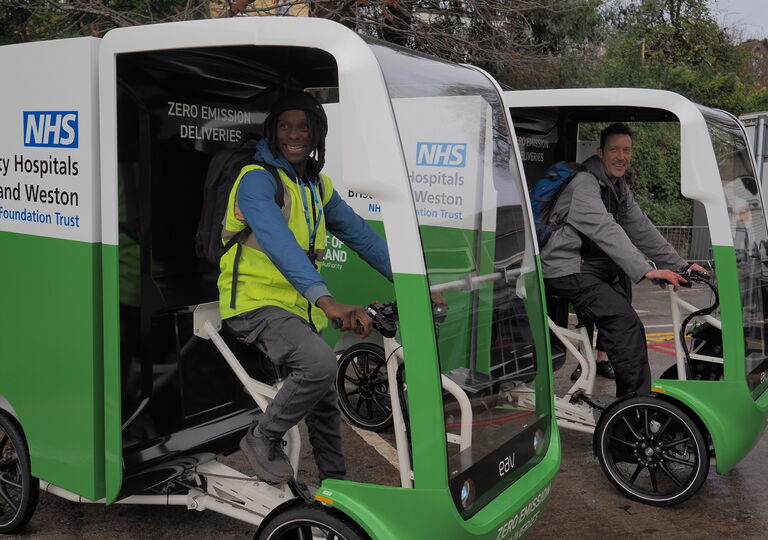
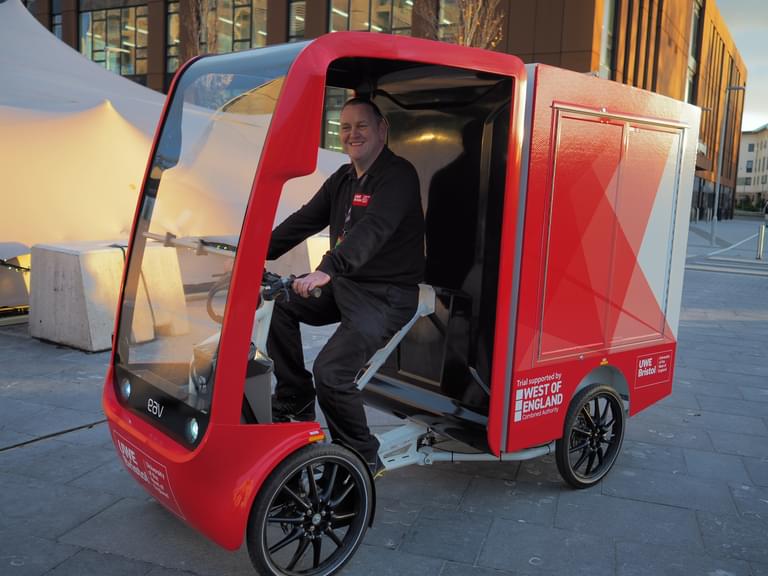
Many businesses in the West are already embracing the benefits of e-cargo bikes, specifically designed to carry goods with electrical motor support.
Unlike vans, they produce no emissions and can use cycle paths to avoid congestion, making them faster, greener, and often cheaper for deliveries in towns and cities. The Mayoral Combined Authority is conducting in-depth trials, proving that e-cargo bikes can replace vans in many scenarios, cutting emissions without compromising quality of service.
We’ve been working with hospitals and universities to test how e-cargo bikes perform in real-world situations, aiming to determine with evidence if an e-cargo bike can replace a vehicle. These institutions often rely on diesel vans for short trips. Each e-cargo bike replaces a vehicle on these same trips, using tracking tools to measure performance, carbon savings, and overall efficiency.
In our Parcels as Passengers trial, we re-thought how goods are delivered between cities, taking advantage of underutilised space in long-distance coaches to move parcels between Bristol and Plymouth. At each end, e-cargo bikes handled the local drop-offs. This removed delivery vehicles from roads, whilst opening up new commercial avenues for companies.
Supporting cleaner communities
In Bristol, we have partnered with WeAreBS3 to launch the online shopping platform OneBasket which showcases local independent retailers. Shoppers get everything in one place and their goods are delivered together in a single, sustainable drop-off by e-cargo bike.
We’re also making e-cargo bikes accessible to businesses and the public through WESTcargo, a short-term rental scheme. Low rates offer easy access when needed without the investment necessary to buy, maintain and store a bike. It’s flexible, low-cost, with ambitions to grow into a commercial, region-wide scheme.
Smarter street use for deliveries
A challenge for road-based deliveries is finding a space to unload. Delivery drivers spend time circling for a space or end up blocking traffic. We’re exploring ‘dynamic kerbside management’ - innovations like timed, bookable loading bays, helping cities use their space more intelligently and efficiently. We are now working on a forthcoming report that will identify and outline the steps needed to hold real-life trials in city-centres.
What the Mayoral Combined Authority has learnt so far
At the end of each 12 month trial, we will analyse and share what we have found, so that businesses and other organisations can effectively put in place their own low-carbon delivery schemes. Here are some of the key learnings that we have identified so far:
Even in organisations committed to sustainability, with the full support of management, implementing change isn’t easy. Providing staff with time and training to use the e-cargo bikes helps to build confidence.
Health & safety policies, shift patterns, and union agreements need to support new ways of working with e-cargo bikes. This varies from place to place and custom solutions are often required.
In our Parcels as Passengers trial, every step from coach to cargo bike had to be secure. Specialist Goods-in Transit Insurance was required, with robust handovers processes keeping goods protected from start to finish.
E-cargo bikes are not a total replacement for vans but work brilliantly for many deliveries. They can provide reduced journey times through use of cycleways and easy parking, especially in city environments, but are most effective as part of a wider fleet strategy.
There is a limited albeit growing pool of cycle repair shops equipped and experienced to maintain large cargo bikes. We’ve helped expand mechanic training to grow local expertise and support a long-term maintenance network.
Employers Guide to E-Cargo Bikes
We’re packaging the learnings into a practical Employers Guide to E-Cargo Bikes, written by Antony de Heveningham of Cargodale, calling on his first-hand knowledge with insights from businesses across the UK. With support from the West of England Mayoral Combined Authority and consultants WSP, the guide fills important gaps for those getting started outside of London.
From choosing the right bike, finding a mechanic to the health and safety of riders, our guide has everything businesses need to know about moving away from van delivery or adding a bike to a fleet.
Continue to
Our Growth Hub is a free support service for small to medium size enterprises (SMEs). We can help you achieve your ambitions through access to national and local business support, funding and training.
Our Thrive at Work programme supports business leaders with the mental health and wellbeing of their workforce.
Download our Business Support Guide for an overview of the support programmes available from Growth Hub.